

Do we need to kill more bucks?
We all want more bucks present in our western mule deer herds and that sentiment has pushed both hunters and wildlife agencies to formulate numerous plans, studies and hunting strategies to make that a reality. The logic has always been seemingly straightforward: more bucks should mean better hunting and, theoretically, better breeding success. But a new study led by researchers at Brigham Young University is flipping that assumption on its head by suggesting that strategy may be working against overall population recovery.
Published this week in the journal Ecological Solutions and Evidence, the paper titled “Dams in distress: Adult sex ratio, female nutritional condition, and population dynamics in mule deer” examines long-term data from Utah mule deer and finds that higher male-to-female ratios are associated with declining nutritional condition in adult does. That, in turn, appears to reduce population growth through lower fawn birth weights, slower fawn growth, and reduced fawn survival.
The work was a collaboration between BYU wildlife professors Brock McMillan and Randy Larsen, post-doctoral researcher Ranjana Pal, the Utah Division of Wildlife Resources, and groups including the Mule Deer Foundation, Rocky Mountain Elk Foundation, and Sportsmen for Fish and Wildlife. To form the study, researchers used 15 years of productivity data and seven years of body-condition measurements collected from free-ranging deer.

BYU wildlife professors Brock McMillan (center) and Randy Larsen (right) receiving the Theodore Roosevelt Conservation Award for their efforts to research and conserve native wildlife across western North America. | Sportsmen for Fish and Wildlife
Each winter, teams captured adult does with helicopter net guns and measured body mass, size, and rump fat before releasing them back into the wild. In areas managed for higher buck ratios, researchers found that does accumulated less fat heading into winter. As many of us know, fat reserves are critical for overwinter survival and for supporting pregnancy and lactation the following year. In some Utah units, adult doe mortality reached roughly 50 percent after the harsh 2023 winter.
“More males really doesn’t help grow the population,” McMillan said. “Agencies and the public have continually pushed to decrease male deer harvest—which increases male-to-female ratios—but this paper suggests that is exactly opposite of what we should do for the mule deer population.”
In their findings, researchers point to two likely mechanisms. When it comes to simple forage competition, adult bucks are about 50 percent larger than does and consume correspondingly more food. Raising the proportion of bucks increases competition for the same limited summer and fall forage, even if total deer density stays the same. The second mechanism researchers pointed to is behavior during the rut. With more bucks on the landscape, does are pursued more aggressively over the short breeding season, causing them to move more, reduce foraging, and put on less fat as a result.
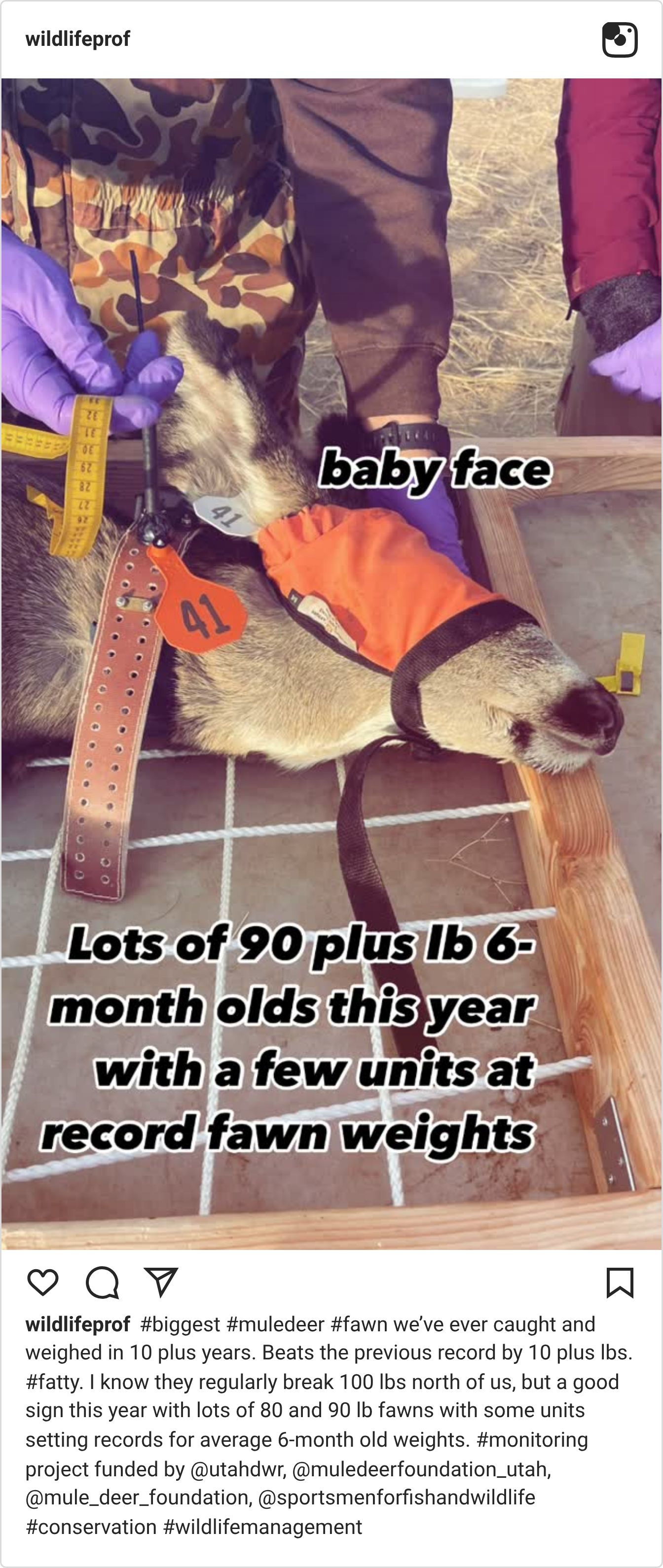
Given that mule deer populations across the West have declined over the past 30 to 40 years, management in many places has shifted toward higher buck ratios, driven by both biological goals and strong public interest in more mature bucks. The study suggests this approach may have produced an unintended trade-off that may have resulted in better buck hunting in the short term, but ultimately ended up slowing overall population growth.
The findings are correlational and therefore based on existing variation in management across units rather than a controlled experiment that deliberately changed buck ratios. The authors note that and call for further work that tests whether reducing male proportions can improve doe condition and population growth. They also flag a potential downstream effect on hunters that could see bucks born to does in poor condition experiencing reduced growth and smaller antlers over their lifetimes.
Whether agencies or the hunting public are ready to act on the idea remains an open question. McMillan acknowledged the counterintuitive nature of the result and the difficulty of gaining buy-in. Still, the data indicate that in at least some Western mule deer herds, harvesting more bucks—not fewer—could be one tool for improving the condition of does and, over time, growing the overall population.
"It's a little counterintuitive that if you remove more animals from the population, that there will be more animals in the population," McMillan said. "There's been a big push from the public to close the hunt in some units so that the populations can recover, and this study says that's exactly opposite of what you should do. You should remove more of the males."
